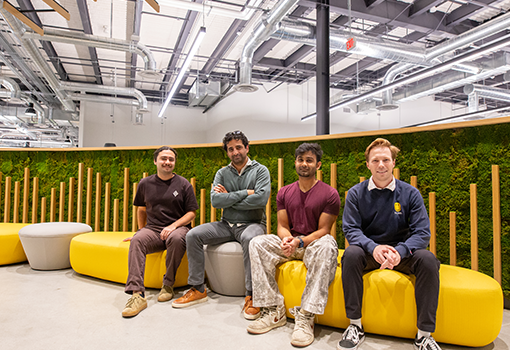
UC Santa Barbara electrical and computer engineering associate professor Kerem Çamsarı is bringing his AI hardware startup, Flucta, to OASIS as the first company founded by a UCSB faculty member to incubate and establish a presence within the facility, marking another step in the College’s efforts to strengthen the region’s growing innovation ecosystem. Managed and operated by The Robert Mehrabian College of Engineering, OASIS was created to help bridge the gap between university research, startup incubation, and industry collaboration near the UCSB campus.
Founded out of years of research in probabilistic computing, Flucta is aimed at developing a new class of artificial intelligence (AI) hardware designed to dramatically reduce the energy and memory demands of modern artificial intelligence systems.
The company emerged from Çamsarı’s research exploring how randomness, traditionally viewed as noise in computing systems, can instead become a computational advantage. “We believe that, if used carefully, controlled randomness can become a powerful computational resource,” said Çamsarı, whose recent honors include an Early CAREER Award from the National Science Foundation and the Misha Mahowald Prize.
Flucta’s technology centers on what the company calls a stochastic processing unit (SPU), aimed at making AI inference more efficient and deployable in power-constrained environments such as robotics, autonomous systems, medical devices, and edge computing platforms.
For Çamsarı, OASIS offered a unique opportunity to remain closely connected to the UCSB ecosystem while building a company with startup urgency. “The location is a spectacular advantage. OASIS is just a few minutes by bike from my office at UC Santa Barbara. That matters a lot,” he said.
The company currently employs four full-time team members, all with PhD or postdoctoral-level ties to the UCSB research ecosystem, working across AI algorithms, inference systems, hardware design, chip prototyping, and computing architectures. Çamsarı said that remaining close to campus was an important factor in the decision to join OASIS because it allows the startup to stay connected to the talent, technical culture, and interdisciplinary environment that helped launch the company.
That proximity also enables faster iteration, a critical advantage in AI hardware development. “In a field like AI hardware, progress often comes from fast iteration between ideas, experiments, prototypes, and feedback,” Çamsarı said. “Being close to campus makes those loops much tighter.”
He added that deep-tech startups require more than workspace alone. “They also need access to talent, ideas, facilities, technical conversations, and an environment where research can turn into engineering. OASIS checks every box.”
Tal Margalith, the college’s executive director of strategic programs and innovation who leads industry engagement and startup incubation at OASIS, said Flucta reflects the facility’s broader mission of accelerating translation and collaboration.
“Flucta represents exactly what OASIS was built to enable, giving startups access to the proximity, infrastructure, and collaborative environment needed to move breakthrough research toward real-world deployment.”
Umesh Mishra, dean of The Robert Mehrabian College of Engineering, said the addition of faculty-founded companies demonstrates how OASIS is helping strengthen the region’s innovation pipeline.
“As someone who has spent much of my career both developing technologies and helping build companies around them, it is especially exciting to see faculty-founded startups beginning to grow within OASIS. This is exactly the kind of environment we envisioned, one where discovery, talent, and industry remain closely connected,” he said.
Flucta joins a growing community at OASIS, which includes Beacon Photonics, the facility’s first industry member. Together, the companies represent the expanding role of OASIS as an important technology hub. Earlier this year, the Biomaterials, Polymers and Advanced Constructs from Integrated Chemistry Materials Innovation Platform (BioPACIFIC MIP), funded by the National Science Foundation to develop advanced bio-derived materials, relocated its laboratories from campus to the 105,000-square- foot facility.
As one of the first startups to join the facility, Flucta plans to use OASIS for both prototyping and translation, developing hardware systems, testing architectures, and building toward commercial deployment. Çamsarı said that being part of the facility from the beginning carries significance beyond his own company.
“It feels like we are helping open a door, not just for Flucta, but for other deep-tech companies that may follow,” he said.
Caption for photo: The Flucta team (left to right) Kemal Selçuk (PhD, ECE, '25); Kerem Çamsari, Founder; Nihal Sanjay Singh (PhD, ECE, '26); Kevin Callahan-Coray