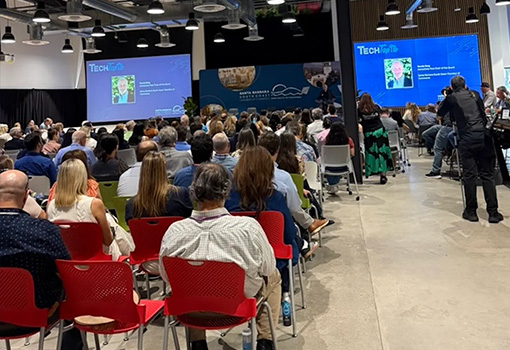
If Deltopia was Santa Barbara’s annual monument to playing hard, then TechTopia may be its answer on the other side of the coin: Work hard.
On Wednesday afternoon, less than a mile from UC Santa Barbara and just off the highway, the Santa Barbara South Coast Chamber of Commerce gathered business leaders, engineers, researchers, and executives at OASIS, a newly opened innovation hub in Goleta, to make a point that locals do not often make loudly enough: Santa Barbara is not simply an expensive surf town with good weather. It is also a place where companies are building quantum computers, cancer diagnostics, semiconductor packaging systems, and software meant to shape entire industries.
“We are home to the highest concentration of PhDs per capita outside Silicon Valley,” said Kristen Miller, president and CEO of the Santa Barbara South Coast Chamber of Commerce. “What we learned was that each individual entity was pulling a lot of weight, attracting talent, and attracting investment, changing the world, and putting out advancements in technology. But there was a longing to work together.”
That desire for collaboration was the through-line of TechTopia 2026, a half-day summit featuring tours, demonstrations, and talks from leaders tied to UC Santa Barbara, Google Quantum AI, Agilent Technologies, AppFolio, and other firms with roots on the South Coast.
It also doubled as something of a public unveiling for OASIS, UCSB’s new 105,000-square-foot research and development facility at 71 South Los Carneros Road. Announced last year, the building is intended to bridge the gap between campus research and industry deployment — a place where faculty researchers, startup companies, and more established firms can work in closer proximity.
Tal Margalith, executive director for scientific initiatives and innovation at the California NanoSystems Institute, led one of the day’s tours through the facility, which includes open office space, wet labs, startup incubation areas, and future semiconductor-packaging infrastructure. Apeel Sciences still occupies part of the building, but UCSB has begun moving research operations into the space.
“OASIS is UCSB’s new venture,” Margalith said, describing it as an extension of the research enterprise on campus that brings university work “a lot closer to the industry” that ultimately adopts new technologies.
The building, he explained, is meant to function as a kind of “step-up incubator” for companies outgrowing smaller campus startup spaces but not yet ready to fully enter the commercial real-estate market. The first startup tenant has already arrived from Virginia, drawn by Santa Barbara’s concentration of photonics, materials science, and semiconductor expertise.
Margalith pointed to one lab under construction for semiconductor packaging — the process that turns fabricated chips into usable devices by connecting them to wires, optical fibers, and other systems — as an example of the infrastructure OASIS hopes to provide.
“This is a gap in, honestly, not just the California infrastructure, but the national infrastructure,” he said.
Click here to read the entire article in The Santa Barbara Independent.