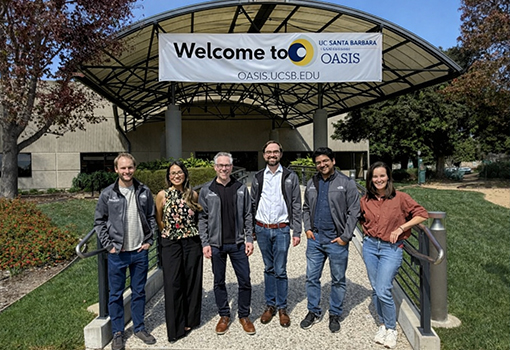
Virginia-based Beacon Photonics has become the newest member of Oasis, UC Santa Barbara’s new innovation and translational research hub, which launched in September 2025.
“And there are two other companies that we are in the midst of signing deals with,” Umesh Mishra, dean of the university’s Robert Mehrabian College of Engineering, which manages Oasis, told the Business Times March 30.
He declined to name the companies for the time being.
Beacon Photonics is the second member of Oasis, Mishra said.
Apeel Sciences, whose technology extends the shelf life of fresh produce and which has UC Santa Barbara roots, was the first, he said.
Apeel used to rent the entire 105,000-square-foot research and development facility located within Goleta’s thriving tech corridor — dubbed TechTopia — adjacent to the UCSB campus.
It now sub-leases part of the building, for which Oasis has the long-term master lease, Mishra said.
In another Oasis development, one of UC Santa Barbara’s major research centers, the NSF BioPacific MIP, has moved from the campus into the facility, Mishra said.
“This will enable it to engage more with industries,” he said.
Headquartered in Arlington, Virginia, Beacon Photonics develops advanced integrated photonic technologies for applications ranging from communications and sensing to quantum systems and national security.
Photonics is the science and technology of generating, controlling and detecting light (photons), serving as a faster, more efficient alternative to electronics.
By establishing “Beacon West” at Oasis, the company is expanding its footprint while embedding itself within a leading photonics research community, according to the university.
“Oasis offers a collaborative environment and shared-use capabilities that are essential for rapid innovation,” Gordon Keeler, co-founder and CEO of Beacon Photonics, said in a March 30 university release.
“Santa Barbara has an exceptional photonics ecosystem, and Oasis gives us a natural place to connect with that community,” he said.
Mishra said that Beacon Photonics “exemplifies what Oasis is designed to enable, taking breakthrough ideas in areas like integrated photonics and rapidly translating them into technologies with real-world impact.”
“Their presence sets a powerful tone for the kind of innovation ecosystem we are building here,” he said.
Oasis launched to spur more innovation and entrepreneurship.
The space features wet and dry lab spaces, while also being equipped with modern office and meeting areas optimized for innovation and translational-focused partnership.
Oasis will be involved in spurring technologies in a number of high-growth sectors, including advanced materials and biotechnology, microelectronics, aerospace, defense, electric mobility, AI and the emerging field of quantum technologies, the university said.
For Beacon Photonics, proximity was a deciding factor in choosing Oasis, Keeler said.
Located just minutes from UCSB’s state-of-the-art Nanofabrication Facility, Oasis enables a tight feedback loop between design, fabrication, and testing, each of which is critical for advancing next-generation technologies, according to the release.
“Santa Barbara has cultivated one of the world’s preeminent photonics research communities,” said Keeler, a former program manager with the Defense Advanced Research Projects Agency with longstanding ties to UCSB.
Being such a short distance away improves Beacon’s productivity, strengthens its connections, and accelerates collaboration with faculty, he said.
“It’s exciting to be part of building something from the ground up,” Keeler said.
Charlotte Flatebo, a senior test engineer at Beacon, said that the partnership creates new opportunities to mentor and train emerging engineers through outreach programs run by the university, further strengthening the regional talent pipeline.
Santa Barbara architect Michael Holliday, who worked with Apeel on the building when the company fully occupied it, said he too, is excited about the Oasis project.
“I think there’s going to be a lot of great new companies that are going to come out of this facility,” Holliday, principal architect at DMHA Architecture + Interior Design, told the Business Times.
Mishra said he’s happy with Oasis’s progress since its launch.
“And nervous at the same time,” he said with a laugh.
“If you’re not nervous and constantly anxious about an endeavor, then there’s something wrong with you, right?” he said.
During his time as UCSB chancellor, Henry Yang’s vision helped create UCSB into an innovation hub, recruiting key academics like LED lighting pioneer Shuji Nakamura to join the faculty before he won his Nobel prize.
Yang stepped down as chancellor in July 2025 after a 31-year tenure.
Written by staff writer Mike Harris